Home › BISP Programs › Benazir Kafaalat Program
Benazir Kafaalat Program 2026, Eligibility, PMT Score, Payment Updates
Check your Benazir Kafaalat Program 2026 eligibility using PMT score and 8171 service. Understand payment methods, registration steps, and latest updates easily. (Also written as Benazir Kafalat Program.)
Last updated: June 2026 — figures on this page (including the Rs. 14,500 quarterly stipend) are checked monthly against official BISP announcements.
⚡ Quick Facts: Benazir Kafaalat Program 2026
Current Stipend
RS 14500/Quarter
Benazir Income Support Programme oversees the Benazir Kafaalat Program as its main initiative to support low-income families in Pakistan. BISP selects beneficiaries through the NSER Dynamic Survey using the PMT score system. Families with lower scores qualify more easily, while special relaxation exists for disabled persons and transgender individuals. This article explains the payment updates, eligibility criteria and eligibility status updates.
Overview of Benazir Kafaalat Program
The Benazir Kafaalat Program is the largest and main program under the BISP umbrella. Benazir Income Support utilizes both unconditional and conditional cash transfer programs. It is an Unconditional Cash Transfer Program, because it does not require any educational or skill-based conditions. The government renamed the program to Ehsaas Kafaalat Program in 2018, and changed it back to BISP Kafaalat again in 2022.
| Feature | Details |
|---|---|
Program Name | Benazir Kafaalat Program |
Organization | Benazir Income Support Program |
Launch Year | 2008 |
Program Type | Unconditional Cash Transfer |
Status | Largest single cash transfer program in Pakistan’s history |
Short-Term Objective | Reduce impact of slow economic growth, food crisis, and inflation on poor families (especially women) |
Long-Term Objective | Eliminate extreme poverty and promote women empowerment |
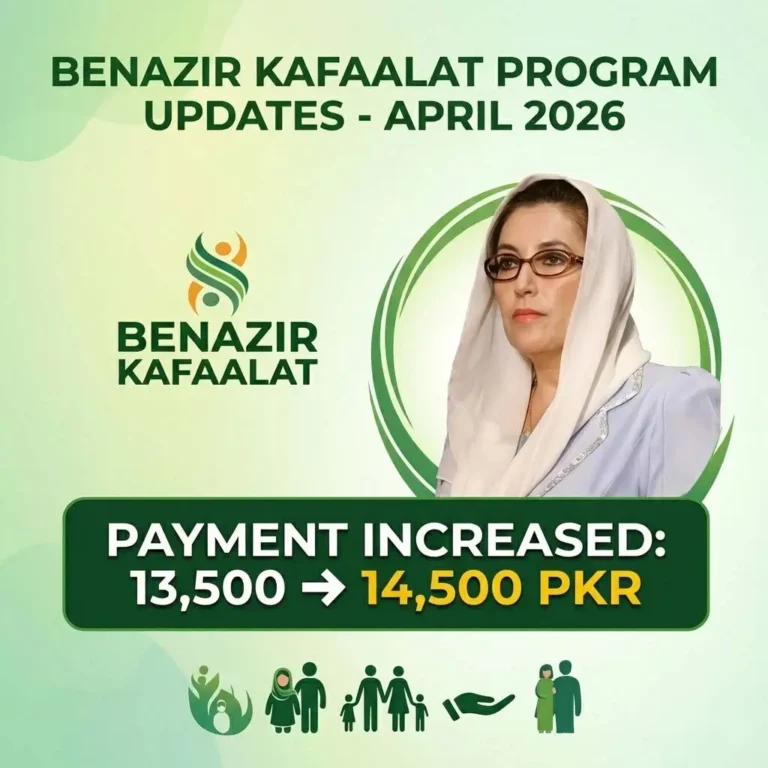
Current Stipend | Rs. 14,500 (Quarterly per beneficiary) |
Eligibility Criteria for Benazir Kafaalat Program
BISP selects the beneficiaries of the Benazir Kafaalat Program through PMT Score based on the National Socioeconomic Registry (NSER) Dynamic Survey. PMT Score has a scale of 0–100. For the Benazir Kafaalat Program eligibility, you should have a PMT score of less than 32. However, in case there is a disabled person in your household, this limit is 37. BISP Board approved this score in the 52nd meeting, held in September 2021.
How to Check Your Eligibility Status for Benazir Kafaalat Program
You can check your Benazir Kafaalat eligibility status in three ways:
- SMS check: Send your 13-digit CNIC number (without dashes) to 8171. You will receive an instant reply showing your registration and eligibility status.
- Web portal check: Visit the official 8171 web portal, enter your 13-digit CNIC number and the captcha shown, then submit to view your status online.
- In person: If your status shows “Not Registered,” visit your nearest BISP Tehsil Office to complete the NSER Dynamic Survey, which is required before you can be considered for the program.
BISP Check Balance and Payment Details
You can check your balance and payment details by sending a 13-digit CNIC SMS to 8171. Also, you can visit the 8171 web portal and enter your 13-digit CNIC number.
You can receive installments through these ways:
Conditional vs Unconditional Cash Transfer Programs
The Benazir Income Support Programme uses both unconditional and conditional cash transfers to reduce poverty.
Conditional Cash Transfer Programs
Conditional Cash Transfer (CCT) programs promote human capital investment by requiring beneficiaries to meet specific conditions, such as enrolling children in school, attending health check-ups, or completing skills training. Under BISP, this includes Benazir Nashonuma, Benazir Hunarmand, and Benazir Taleemi Wazaif. These programs target specific behaviors and outcomes, in addition to providing financial support.
Unconditional Cash Transfer Programs
BISP’s main program, the Benazir Kafaalat Program, is an Unconditional Cash Transfer (UCT) program. It offers immediate funds for relief in case of basic needs and provides flexible financial support regardless of any condition — beneficiaries do not need to meet any education, health, or skills-based requirement to continue receiving it.
| Feature | Unconditional (UCT) | Conditional (CCT) |
|---|---|---|
Requirements | None | Must meet education, health requirements |
Focus | Immediate Consumption & Poverty Relief | Human Capital (Education, Health, Skills) |
BISP Application | Quarterly Stipend (Kafaalat) | Benazir Taleemi Wazaif |
Flexibility | High (Beneficiary Choice) | Low (Targeted Behavior) |
Administrative Cost | Lower | Higher |
Benazir Kafaalat Program Key Updates 2026
Since its launch in 2008, BISP has refined the Benazir Kafaalat Program several times. The most important updates for 2026 are:
Next of Kin Policy
BISP has introduced a Next of Kin policy to ensure that financial support continues even after the death of a registered beneficiary. If a beneficiary passes away, their family should not be left without support. A legal heir or next of kin from the same family can take over and become the new beneficiary. This transfer is done through a proper appeal and verification process.
Documents Required for Re-verification
How Transgender Individuals Can Apply for BISP Kafaalat Program
Benazir Income Support Programme (BISP) has recently taken an important step by approving a policy to include transgender individuals in the Benazir Kafaalat Program for financial assistance.
Transgender individuals must obtain a valid CNIC from NADRA, clearly mentioning their gender as transgender. After getting the CNIC, they should complete the NSER survey at the nearest BISP Tehsil Office. This survey is mandatory for registration and inclusion in the program.
Unlike other applicants, BISP has relaxed the PMT cut-off for them. This means that all transgender persons who complete the survey can apply, regardless of their poverty score.
After approval, they start receiving cash assistance through BISP’s partner banks using secure payment methods.
Latest BISP Payment System, Methods, Process & Updates Explained
BISP experimented with different payment distribution mechanisms throughout 18 years, from 2008 to the present. Currently, there are five payment disbursement mechanisms.
Pakistan Post Money Orders
In the early days (2008–2012), BISP used the traditional postal system and sent the cash to beneficiaries through money orders delivered by postmen to their homes. This method was simple but had issues like delays, leakage, and a lack of transparency.
Smart Card Payment Dispersion System
BISP gave beneficiaries a smart card like an ATM card. They could withdraw money from designated ATMs or agents. This improved security and reduced corruption, but it required a basic technical setup.
Mobile Banking System
BISP started transferring payments through mobile wallets like Easypaisa or JazzCash. Beneficiaries could receive SMS alerts and withdraw money from nearby agents. This method made payments faster and more convenient, especially in remote areas.
Debit Card System
BISP partnered with banks to issue debit cards. Beneficiaries could withdraw their payments from ATMs.
Biometric Verification System
This is the current and most secure method. Beneficiaries receive payments after verifying their identity through fingerprint scanning at authorized agents. It ensures that only the rightful person gets the money.
Conclusion
As of the April 2026 update, the Benazir Kafaalat Program provides Rs. 14,500 per quarter to households with a PMT score below 32 (below 37 for households with a disabled member), selected through the NSER Dynamic Survey. Eligible families can confirm their status by sending their CNIC to 8171, through the 8171 web portal, or at their nearest BISP Tehsil Office. Because the program periodically updates its stipend amount, PMT cutoffs, and payment methods, bookmark this page or check our latest BISP 8171 updates for the most current figures.