
NSER Dynamic Survey for BISP 8171: How to Register and Check Eligibility (2026)
A complete guide to the National Socio-Economic Registry survey — documents, PMT score, appeal process, and what happens after registration.
Registration: Open at all BISP Tehsil Offices — in-person only, no online option

Quick Summary
NSER Dynamic Survey is the updated system by the Benazir Income Support Programme to keep household data of Pakistani families up to date, identify eligibility for cash transfer programs, or check PMT Score. According to BISP’s official records, the registry now covers approximately 40 million households across Pakistan.
Warning — Fake NSER Survey Websites and Paid Agents
Thousands of fake websites claim to register you for BISP online or offer to “speed up” your NSER survey for a fee. Every single one of them is a scam.
The only real portal: 8171.bisp.gov.pk
NSER at a Glance: Key Facts (2026)
| Fact | Details |
|---|---|
| Registry Established | 2011 |
| Current Coverage | ~40 million households (~84% of Pakistan’s population) |
| Still Unregistered | ~2.2 million households (bottom 40%) — World Bank Assessment, Nov 2025 |
| Survey Method | CAPI (Computer Assisted Personal Interview) + biometric verification via NADRA |
| Kafaalat Payment | Rs. 14,500 per quarter (as of March 2026) |
| Payment Months | January, April, July, October |
| PMT Eligibility Threshold | ≤32 standard | ≤37 with disabled household member | No restriction for transgender individuals |
| Recertification (beneficiaries) | Every 3 years |
| Cyclic Update (non-beneficiaries) | Every 2 years |
| Registry-Wide PMT Update | Every 4 years |
| Emergency Response | Shock-responsive — activated after government notification (2022 floods, 2025 floods) |
| Data Sharing (since 2019) | 29 organisations, 50 datasets released |
| BISP Helpline | 0800-26477 (free, Mon–Fri, 9am–4pm) |
| Official Portal | 8171.bisp.gov.pk |
Overview of NSER
The Benazir Income Support Programme established the National Socioeconomic Registry in 2011 as a major social safety program. In 2010, NSER maintained a database of 27 million (2.7 crore) households. Back then, 2 agencies of the Federally Administered Tribal Area were not included — the Khyber Agency and the Bajaur Agency. The survey covered 87% of the country’s population using pen-and-paper-based personal interviews (PAPI). By 2021, this grew to 35 million households, and according to a World Bank NSER Assessment published in November 2025, the registry now covers approximately 40 million households — representing 84% of Pakistan’s population.
BISP and other programs use this data to check the eligibility status of applicants through the Proxy Mean Test (PMT Score). Families with a PMT score below the national poverty threshold (typically below 32) qualify for Benazir Kafaalat and other BISP programs. The main objective of this social protection Pakistan system is to ensure that funds reach all eligible families.
What Is the NSER Dynamic Survey — and Why Does It Decide Your BISP Eligibility?
The NSER Dynamic Survey is Pakistan’s official household poverty registration system. Your survey data determines your PMT score, and your PMT score determines whether your family receives Rs. 14,500 every quarter.
The National Socio-Economic Registry (NSER), managed jointly by BISP and NADRA, is a database containing the socioeconomic profile of Pakistani households. It was first established in 2011 as a static registry — surveys were conducted once every several years. The problem with that approach was clear: families whose circumstances changed between surveys had no way to update their records, and families who missed a survey window had no path to register.
The Dynamic Survey solves this. Registration desks are permanently open at BISP Tehsil Offices across Pakistan. Any family that was missed in previous surveys, or whose circumstances have changed, can visit at any time.
BISP uses your NSER data for all of these programmes:
Who should complete or update the NSER Dynamic Survey?
| Feature / Aspect | Details |
|---|---|
| Established | 2011 |
| Initial Data Collection | 27 million households (2010), door-to-door survey |
| Purpose | Platform for BISP and other programs to improve targeting efficiency |
| 2016 NSER Update | Survey design and questionnaire updated |
| 2019 NSER Update | Field data collection |
| Updated Coverage | 35 million households |
| Survey Method | Computer Assisted Personal Interview (CAPI) |
| Dynamic Registry Transition | Multi-Entry Localized-Access (MELA) framework for continuous updates and re-verification |
| Verification & Security | Linked with NADRA for secure verification of citizen information |
| Special Features | Shock-responsive system for calamity-affected areas |
Step-by-Step Guide to Complete the NSER Dynamic Survey
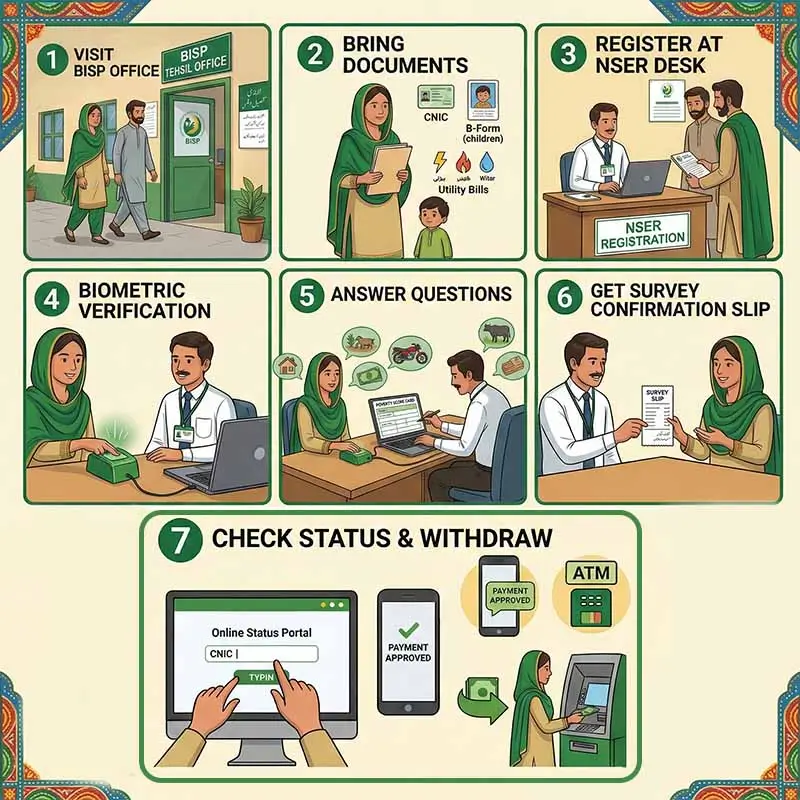
The NSER Dynamic Survey allows BISP to regularly update household data, add new households, and track the BISP eligibility check status of families across Pakistan. Follow these steps to complete your CNIC verification and household registration process:
1
Check your current 8171 status first
Before going to the Tehsil Office, send your 13-digit CNIC to 8171 by SMS or check at 8171.bisp.gov.pk. If your status shows “Eligible” and you are receiving payments, you may not need to visit. If it shows “Not Eligible,” “Survey Required,” or a 933 error, you need to update your record.
2
Prepare your documents — bring all of these
3
Visit your nearest BISP Tehsil Office
Registration desks are open Monday to Friday. Arrive early — urban offices have long queues. Tell the staff at the entrance you are there for the NSER Dynamic Survey, not a payment query. You will be directed to the correct counter.
4
Register at the NSER desk
A staff member will open your household record and confirm or enter your details — family size, address, members’ CNICs, B-Forms, and socioeconomic information. Answer every question honestly. Incorrect data can produce a wrong PMT score and cause rejection later.
5
Provide biometric verification
You will provide your thumbprint, cross-referenced against NADRA’s national database. If your fingerprints do not register — common for elderly women and those doing physical work — tell the staff immediately. They have an alternative verification process available.
6
Answer the socioeconomic questionnaire
The surveyor will ask about your household income, assets (land, vehicles, livestock), housing conditions, education levels, utility access, and employment status. This data calculates your PMT score. A score of 32 or below qualifies you for Kafaalat.
7
Collect your confirmation slip
After the survey, you receive a confirmation slip with your registration reference number. Keep this. If delays occur, this reference number is what Tehsil Office staff will need to track your application.
What Happens After You Complete the NSER Dynamic Survey?
Processing happens in stages. Here is the realistic timeline and what to expect at each point.
1
Immediately — confirmation slip
You receive a slip with your registration reference number. Keep it. This is proof of completion and what staff need if delays occur.
2
10–14 days — 8171 status updates
Your data is processed and cross-verified with NADRA. Check your status by sending your CNIC to 8171 or at 8171.bisp.gov.pk.
3
4–8 weeks — payment approval
If your PMT score qualifies, your name is added to the Benazir Kafaalat list. Your first payment is released in the next quarterly cycle — January, April, July, or October. You will receive an SMS when payment is approved.
Important: BISP does not pay back missed installments. If your survey is completed in September, your first payment will be in October. The quarter missed during processing is not recovered.
Check Your BISP 2026 Payment Status
What your 8171 status means after the survey?
| Portal Status | What It Means | What to Do |
|---|---|---|
| Eligible | PMT score qualifies. Payment processing has begun. | Wait for payment SMS or check collection dates |
|
Under Verification | Data still being cross-checked with NADRA | Wait 7–14 more days and check again |
| Not Eligible | PMT score is above the threshold | Visit Tehsil Office if you believe your data is wrong |
|
Survey Required | Your NSER record is outdated or missing | Visit Tehsil Office to complete Dynamic Survey |
| 933 Error | Your NSER record is incomplete | Visit Tehsil Office with your original CNIC |
Static vs Dynamic Surveys
Static Social Registries
It collect the updated data of households after 3 or 5 years. It is because the Static registries need 2 to 3 years to update the data. For example, the National Socioeconomic Registry of Pakistan took 2 years in 2011 and three years in 2021.
Dynamic Surveys
In dynamic surveys, registration for the survey is always open and continuous. So, anyone can either apply for the registration or update the already given information at any time.
What is the need for the NSER dynamic survey?
In emergencies, a fixed registry cannot quickly deliver funds to needy families. Dynamic surveys serve as a shock-responsive or adaptive social system capable of responding to crises like floods and earthquakes. According to BISP official records, this system was activated during Pakistan’s 2022 and 2025 floods to rapidly identify and support affected households.
The challenge for a fixed survey is that new families in need — or families whose circumstances have changed between surveys — cannot register themselves or update their household information. This problem is especially acute when the same registry is used across different programs, causing many eligible families to miss out on benefits.
A fixed list system is least agile during crisis situations like flood relief, accidents, or earthquakes. Therefore, the NSER Dynamic Survey was introduced to ensure the registry is always current, new families can apply at any time, and the system can quickly respond to disaster-affected populations across Pakistan.
NSER Evolution in Pakistan – From Static Survey to Dynamic Registry
BISP updated the NSER database of Pakistani households many times from 2011 to the present. BISP approved an update of the National socioeconomic registry database in July 2015. They decided in the meeting that NSER will update the data in two phases, Phase 1 and Phase 2, using a computer-assisted personal interviewing (CAPI) approach. NSER also updated the factors that can affect the PMT score. The whole country was divided into 8 clusters.
In 2017, NSER selected 15 districts for their pilot scale update program through self-registration desks and door-to-door surveys. However, NSER updated major household data between 2019 and 2021. For the door-to-door survey, they contracted many Partner Organizations and operations firms to complete this. However, this faced many difficulties, so BISP had to adopt two additional sources, the Desk-Based registration model and the Teacher-based Census Model.
Desk-Based Registration & BISP Registration Centers
In this model, NSER placed 2 to 5 counters in each BISP Registration Center and kept them operating for five months. After that, NSER kept only one or 2 counters, and others were shut down. Those remaining functional NSER counters are now BISP Tehsil Offices.
Teacher-Based Model
NSER could not obtain a No Objection Certificate for CAPI-based survey in cluster 4 and cluster 8, and for Sialkot and Narowal. Therefore, NSER approved the teacher-based model for those districts. In this strategy, junior teachers acted as the enumerators and collected the data, while senior teachers and trained IT teachers supervised those teachers.
Who Manages the NSER Survey?
BISP Headquarters Islamabad — overall management and policy
BISP Zonal and Tehsil Offices — field operations and public registration desks
Operations Review Firm (OR) — independent quality auditing
Ministry of Poverty Alleviation and Social Safety — federal oversight
NADRA — biometric CNIC verification and citizen data validation
Government of Pakistan — federal policy and funding oversight
Provincial Education Departments — supported teacher-based data collection model
World Bank — international funding and technical support
Asian Development Bank — international funding and technical support
Transition from Static to Dynamic Registry 2026
BISP took several steps in moving towards a dynamic registry. As a first step, Benazir Registration Desks have been established at the tehsil level. According to BISP’s official records, when NSER fully implements the Multi-Entry Localized-Access (MELA) dynamic registry, multiple sources — including BISP registration desks, mobile apps, and NSER registration vans — will allow families to report and update their household data continuously.
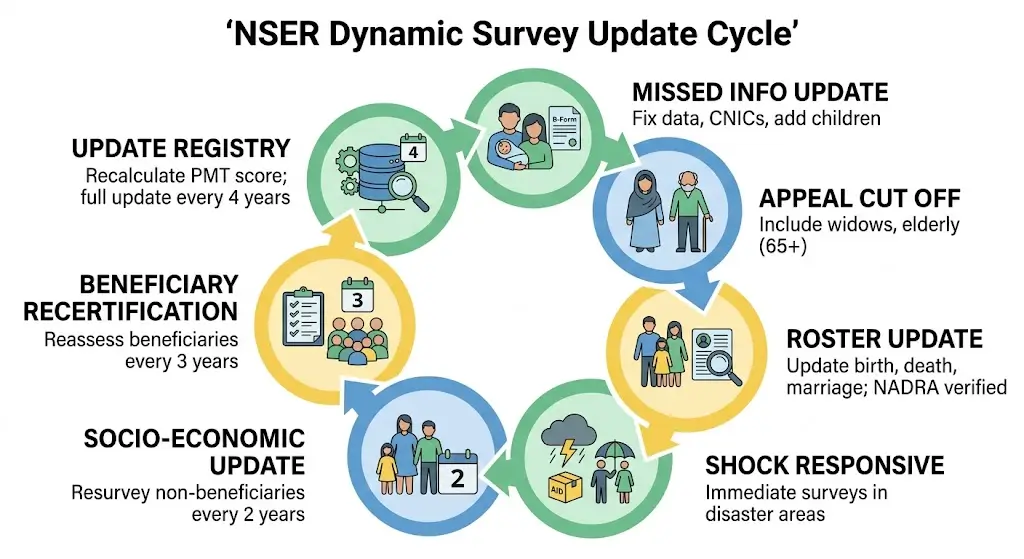
NSER Dynamic Registry Process Cycle
According to BISP’s official framework, the NSER dynamic survey uses 7 steps to keep household data accurate and up to date across Pakistan.
Update Missed Info
Fix missing data, resolve CNIC verification issues, and ensure children have B-Forms.
Appeal Cut-off
Include excluded families — widows, elderly, or small households — through the appeal process.
Roster Update
Update birth, death, marital status, and disability info — cross-verified with NADRA.
Shock Responsive
Immediate survey of disaster-affected areas after official government notification — activated for 2022 and 2025 Pakistan floods.
Cyclic Update
Every 2 years: Reassess non-beneficiary households for updated poverty scorecard eligibility.
Recertification
Every 3 years: Confirm eligibility of existing BISP beneficiaries.
Registry Update
Every 4 years: Recalculate poverty scores (PMT Score) for the entire NSER database.
NSER Data Sharing with Government Schemes – How BISP Supports Social Programs
NSER launched its data publicly in January 2019. According to BISP official records, BISP uses the NSER data to identify eligible families for cash transfer programs including Benazir Kafaalat Program, Benazir Taleemi Wazaif, Benazir Nashonuma and Benazir Hunarmand Program. Various public and private sector organizations and research institutes can also request specific datasets — including disabilities, demographics, and education data. Since its public release, 29 organizations have acquired 50 different dataset sets. The government used this data during the Coronavirus pandemic, the Hernai Earthquake, the Line of Control crisis, the 2022 floods, and the 2025 floods.
NSER uses a comprehensive questionnaire covering the following socioeconomic survey Pakistan categories:
Socioeconomic Status
Use of Fuel
Income support
Usage of Electricity and Gas
Level of Education and Educational Growth
Workforce Profiling
Livestock
Adult Literacy Rate
Children Literacy Rate
Women Literacy Rate
Employment Status
Disabilities
Agricultural Land Ownership Profiling
Diseases Profiling
Infant Mortalities
Law Abiding Status
What Is the Difference Between NSER and PSER — Do You Need Both?
NSER is for BISP programmes run by the federal government. PSER (Punjab Socio-Economic Registry) is a completely separate survey for CM Punjab schemes. Being in NSER does not automatically register you in PSER.
| Feature | NSER | PSER |
|---|---|---|
| Run by | Federal government — BISP | Punjab provincial government |
| Programmes it unlocks | BISP Kafaalat, Taleemi Wazaif, Nashonuma, Hunarmand | CM Punjab Rashan Card, E-Taxi, E-Bike, Kisan Card, Asaan Karobar |
| How to register | BISP Tehsil Office | Punjab government registration points |
| Check status | SMS to 8171 or 8171.bisp.gov.pk | SMS to 8123 or cmschemes.punjab.gov.pk |
| Are they linked? | No — each requires a separate survey and registration | No — each requires a separate survey and registration |
How Your NSER Survey Connects to the Benazir SIM Digital Wallet (2026)
In 2026, BISP began distributing free SIM cards to eligible women to receive payments directly in a digital wallet. Your NSER registration determines whether you are eligible.
Benazir SIM Wallet — Key Facts
- Being registered in NSER with a qualifying PMT score makes you eligible to receive a free Benazir SIM
- The SIM and wallet activation are completely free — no fee at any stage
- You do not need an existing bank account
- No withdrawal fees apply — confirmed by BISP despite earlier rumours
- Activate the wallet before your next quarterly payment — payments to unactivated wallets may be delayed
What Happens After You Complete the NSER Dynamic Survey?
Note: Processing may take 4–8 weeks. If you do not receive a message, visit your nearest BISP Tehsil Office and ask about your application status.
Why Are Some Families Still Missing from NSER — and How to Fix It
Despite covering 40 million households, approximately 2.2 million families from the bottom 40% remain unregistered. Here are the most common reasons — and the exact fix for each.
Expired or invalid CNIC at the time of survey
The NSER system cross-verifies every CNIC with NADRA in real time. An expired CNIC causes incomplete registration. Fix: Renew your CNIC at NADRA first, then visit the BISP Tehsil Office.
Children without B-Forms registered with NADRA
Children not listed in NADRA’s system via B-Form cannot be included in your household record — raising your PMT score artificially. Fix: Register all children at NADRA (free), then bring the B-Forms to the Tehsil Office.
Household moved without updating address
Common for women who married and moved to a different district — their CNIC still shows their father’s address. Fix: Complete the NSER Dynamic Survey at the Tehsil Office in your current district with a utility bill showing your current address.
Living in a remote or hard-to-reach area
Some rural areas were not reached during earlier surveys. BISP continues to run mobile NSER registration vans. Fix: Register directly at the nearest BISP Tehsil Office — registration desks are always open.
Household circumstances changed since last survey
If your situation has worsened since the last survey, your old data may not reflect your current poverty level. Fix: Request a Dynamic Survey update at your nearest Tehsil Office.
If your household was incorrectly excluded, you can file an appeal at your nearest BISP Tehsil Office under the “Appeal Cut-off” step of the dynamic survey process.
My NSER Data Is Wrong and I Got “Ineligible” — What Can I Do?
If the 8171 portal says “Not Eligible” and you believe your household survey data is incorrect or outdated, you have an official right to appeal — and it is free.
This is one of the most common problems in the BISP system. Thousands of families receive an ineligible result not because they are genuinely above the poverty line, but because their NSER record contains old or wrong data — an asset they no longer own, an income they no longer earn, or a family member who moved away.
When can you request a Dynamic Re-survey?
- Your household’s financial situation changed significantly since the last survey (job loss, death of earner, medical expenses, flood damage)
- The surveyor recorded incorrect data — wrong asset counts, wrong address, wrong family size
- Your NSER survey is more than 2 years old
- You moved to a different district and your address record is outdated
- A family member listed in your record passed away and the death was not recorded
How to request a re-survey — the exact steps
- Visit your nearest BISP Tehsil Office. Tell staff you want to request a Dynamic Survey update or re-verification, not just a status check.
- Ask for the appeal or re-verification form. Bring supporting documents for the change — a death certificate, disability certificate, property sale document, or similar.
- Your household information is updated in the NSER system by the staff member at the desk — in real time.
- A new PMT score is calculated from the corrected data. Processing takes 10–30 days.
- Check your updated status on the 8171 portal or by SMS after 14 days.
Conclusion
The NSER Dynamic Survey represents Pakistan’s most comprehensive effort to ensure social protection funds reach deserving families in real time. As of 2025, the registry covers approximately 40 million households — yet around 2.2 million households from the bottom 40% of the population remain unregistered, according to the World Bank’s November 2025 NSER Assessment. If your family has not been surveyed, or if your household circumstances have changed, visiting your nearest BISP Tehsil Office is the fastest way to update your record and protect your BISP eligibility. Use the links below to check your current status or locate your nearest office.